
Brazilian samba · learn from zero
How to Dance Samba: Brazilian Samba no Pé, Step by Step
Search how to dance samba and Google will hand you two different dances with the same name. This page is about the Brazilian one — samba no pé, the fast, solo footwork of Rio Carnival — and it starts where most tutorials skip straight past: the pulse, before any step.
No prior dance experience is assumed anywhere on this page. If you have ever decided you have no rhythm, or that your body is too stiff for a dance like this, there is a section further down for exactly that.
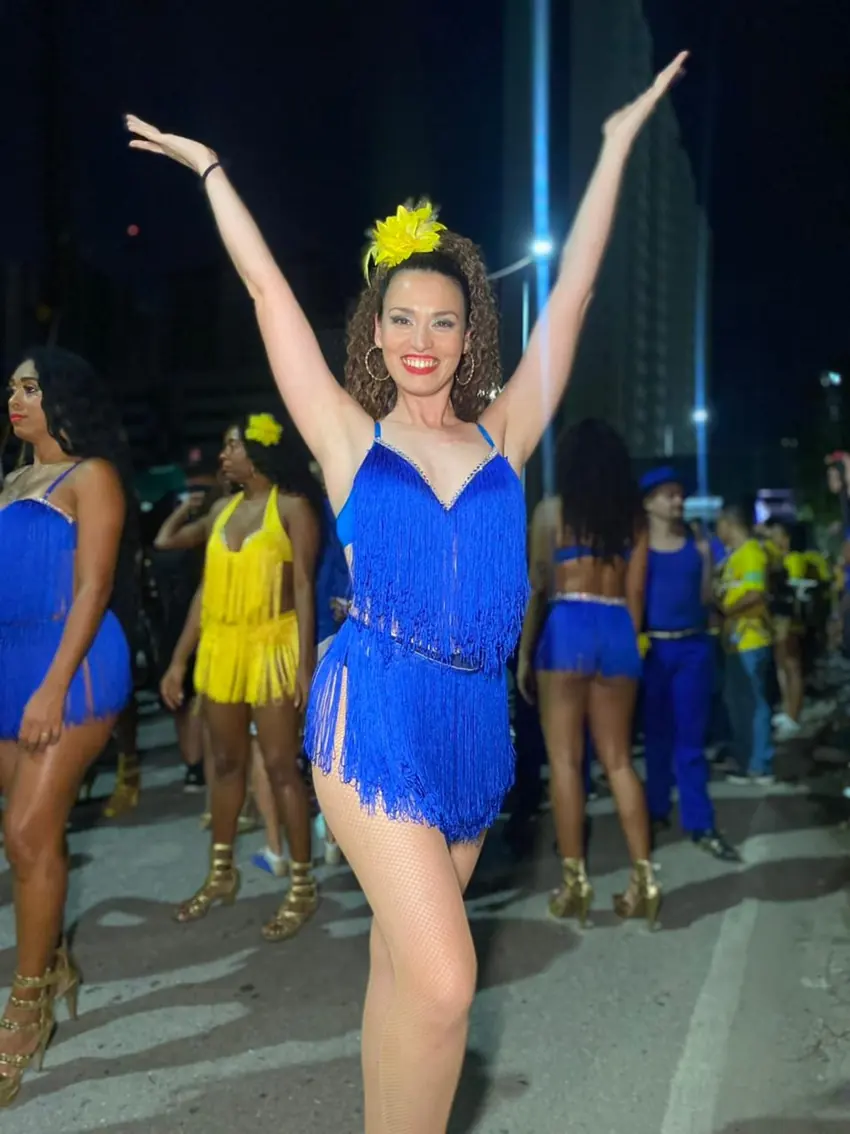
Brazilian samba vs. ballroom samba: which one are you looking for?
The English-language results for “samba” mix at least four dances that are related by history and by name, and by almost nothing else. Sorting them out first will save you weeks of practising the wrong thing.
| Samba no pé | Brazilian, danced solo and upright, travelling very little. This is the samba of the escolas de samba and of the passistas in the Rio Carnival parade. It is a living street and Carnival tradition rather than a codified syllabus, so step names vary between teachers, schools and regions. This page teaches this one. |
| Ballroom samba | The International Latin competition dance. A partner dance, danced in hold, standardised outside Brazil in the middle of the twentieth century. It borrowed Brazilian names — botafogo, volta, corta jaca — for figures that were then fixed into a syllabus, along with whisks, samba walks and criss-cross voltas, and a defined bounce action. |
| Samba de gafieira | Also Brazilian, also a partner dance, born in Rio’s dance halls — the gafieiras. It has its own lead-and-follow vocabulary and looks closer to a Brazilian tango than to either of the two above. |
| Samba de roda | The older circle form from Bahia, danced in a ring with singing and clapping, and one of the roots the others grew from. |
A quick test while you are watching a video: if the teacher mentions a partner, a hold or a “reverse basic”, you are watching ballroom samba. If they say samba no pé and passista, you are in the right place for this page.
What samba no pé is
Samba no pé translates literally as “samba in the foot”. It is the individual samba: no partner, no hold, no lead. The entire dance is built out of one repeating weight pattern in the feet, and everything else you see — the hips, the arms, the travel, the speed — is a variation played on top of that one pattern.
Which is good news for a beginner. There is exactly one thing to get right first.
Before the steps: the pulse of samba
Samba is written in 2/4 time — two beats to the bar — and it moves quickly. The part that catches almost everyone out is that the basic footwork puts three weight changes inside those two beats.
Counted out loud it is usually taught as “1 – a – 2”, or “one and two”: a step, a very quick step, and another step. The middle one is the shortest of the three and it sits close up against the beat that follows it. Even it out into two tidy steps and the samba turns into a march.
Because three weight changes do not divide evenly into two beats, the foot that begins the pattern swaps every bar — right, then left, then right again. That alternation is the engine of the whole dance, and it is why samba keeps moving forward instead of sitting still.
A two-minute exercise, before any footwork:
- Put on a samba track and clap only the strong beats — the 1 and the 2. Nothing else.
- Keep clapping and slot the “a” in between them, so you are clapping the full 1-a-2. Let it stay uneven.
- Stop clapping and hand it to your legs: bend and release the knees on that same count, feet still flat on the floor.
That is more useful than an hour of copying footage, and it is the step nearly every tutorial leaves out.
The eight basic samba no pé steps
Samba no pé has no official syllabus, so treat the names below as the ones you will hear most often rather than as an authority. What matters is what each one does to the basic pattern — the label is just a handle.
1. Samba no lugar — the basic, on the spot
The whole dance in one pattern. Feet under your hips, weight forward over the balls of the feet, knees soft and never locked. Dance the 1-a-2 in place and let the starting foot alternate each bar. Nothing travels yet, nothing swings yet. Every other step on this list is this one, modified.
2. Miudinho — the small, quick one
Miudinho means “tiny”. It is the same pattern shrunk as small and as low as it will go, with the feet barely leaving the floor. This is the version that survives when the music speeds up, and it is what a lot of passistas are actually doing when the footwork looks impossibly fast.
3. Caminhada — travelling the basic
The same 1-a-2, now going somewhere. Send the first step of each bar forward or back instead of underneath you and the pattern walks. Keep the steps short: samba covers far less ground than it appears to.
4. Caminhada cruzada — the crossing walk
The travelling version with the stepping foot crossing in front of the standing one rather than landing beside it. Crossing narrows your base, so the hips have to rotate to make room for it — and that rotation, not the crossing itself, is the point of the step.
5. Balanço — the swing
Balanço is swing. Instead of holding the torso quiet, let it answer the feet: the weight travels a little further to each side, and the ribcage and shoulders swing against the hips. The footwork underneath does not change at all.
6. Puladinho — the little hop
A bouncier reading of the basic, where the “a” of the count lifts off the floor instead of staying grounded. It raises the temperature of the dance and it is much harder to sustain than it looks. Build it once the basic runs without you thinking about it, not before.
7. Rebolado — the hip action
Rebolar is to swing the hips. Danced as its own step, the feet stay small and the rotation of the pelvis becomes the loudest thing in the body. Worth being precise here: in samba no pé the hips are normally a consequence of the knees and ankles working, not something you push on purpose. The rebolado is the one place where you do drive them.
8. Escovinha — the brush
Escova means brush. The working foot sweeps along the floor — forward, back or across — instead of stepping cleanly onto it. It is a decoration you drop into the basic to break up a long run of the same pattern, not a step you build a dance on.
Where the movement actually comes from
| Weight forward | The balls of the feet carry the load. Heels lower towards the floor but never settle onto it. Flat-footed samba cannot reach the speed and cannot rebound. |
| Knees and ankles | They flex and release on every single weight change. That is what produces the small vertical rise and fall you can see running through a passista’s whole body. |
| Hips follow | Nearly every beginner tries to lead with the hips. In samba no pé they are downstream of the legs: get the legs right and the hips arrive without being asked. |
| Torso tall | Long spine, shoulders down and back, eyes up. Samba no pé is danced upright. Leaning forward to “help” the feet is the most common posture mistake there is. |
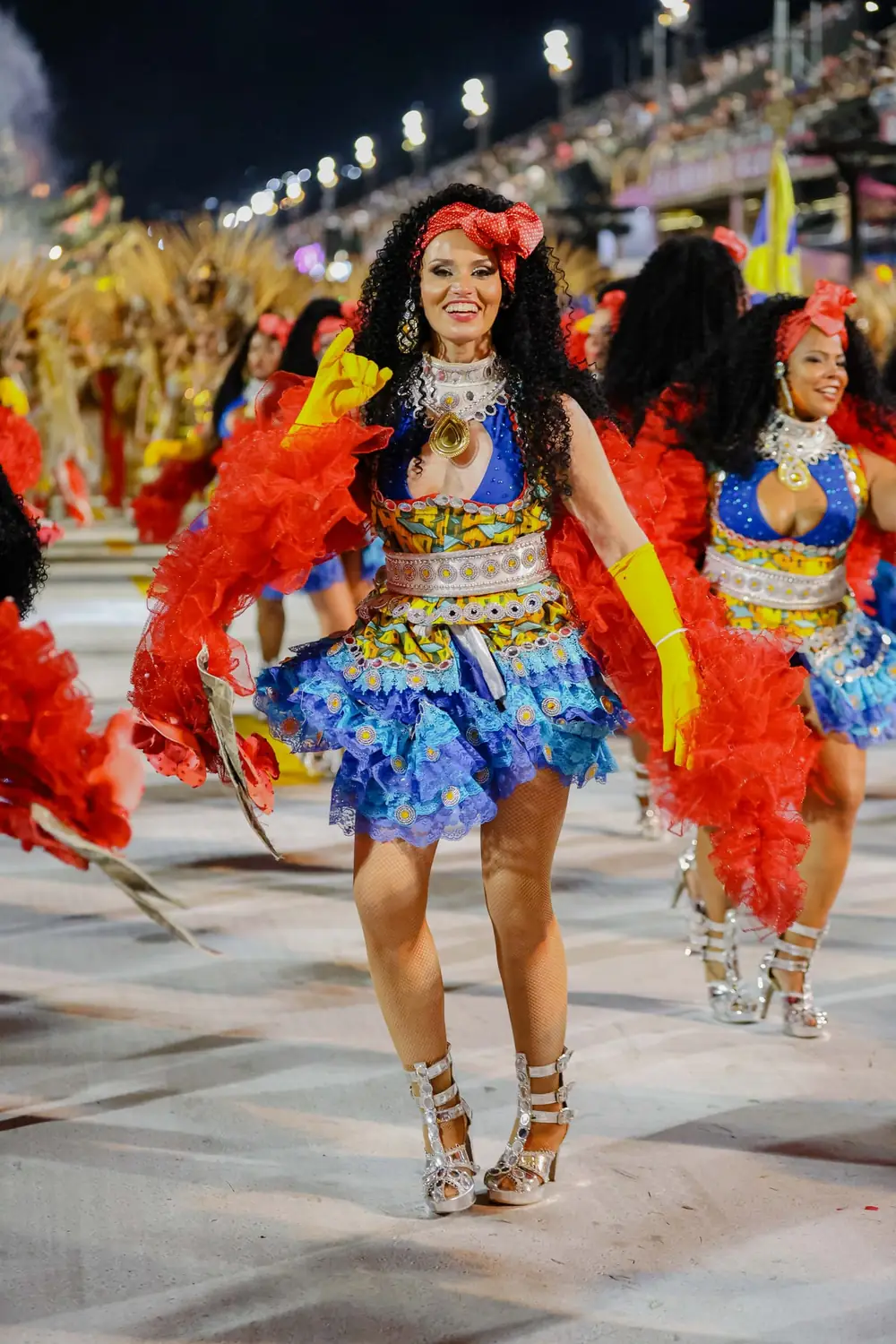
How to practise, and in what order
These are stages, not a timetable. Move on when the previous one stops needing your attention, whenever that happens to be.
| One — the pulse | Clapping and shifting weight only. No steps at all. |
| Two — the feet | Samba no lugar, slowly, until the alternation happens without you counting it. |
| Three — the size | Shrink the same step down into the miudinho, then let it travel as a caminhada. |
| Four — the body | Add the balanço, then the rebolado, then the decorations. |
| Five — the speed | Only now put on a fast samba-enredo track. |
Most people run this list backwards. They start with a fast Carnival track and try to copy the hips, and when it does not work they conclude they cannot dance. It was the order, not the body.
If you think you have no rhythm
- “I have no rhythm.” Almost always a listening problem rather than a body problem. Practise finding the 1 and the 2 sitting down, with no pressure to move, until you can do it without looking for it.
- “I am too stiff.” Stiffness is usually locked knees and a held breath. Soften the knees, breathe out on the “a”, and a surprising amount of the movement turns up on its own.
- “I cannot coordinate.” Coordination is an outcome of repetition, not a requirement for starting. Add one layer at a time — feet, then torso, then arms — and never two at once.
- “I will never dance at that speed.” Nobody starts there. Speed is the last stage on the list above, and it is the one that arrives on its own once the pattern is automatic.
Common mistakes
- Dancing flat-footed. The rebound lives in the ball of the foot. Lose it and the samba goes heavy.
- Evening out the count. Two tidy steps instead of three uneven ones is the single most common error. The “a” has to stay short.
- Making the steps too big. Big steps cannot be danced at samba speed, and samba travels far less than it looks.
- Forcing the hips. Pushing them independently locks the knees, which then removes the very thing that was going to move them.
- Starting at full tempo. Learning the pattern at Carnival speed teaches you a rushed version of it that has to be unlearned later.
- Practising to the wrong music. Use actual samba — pagode and partido alto to start with, samba-enredo once you are faster. Generic “Latin” playlists will not give you the feel.
- Leaning forward. Samba no pé is danced tall. Tipping the chest towards the feet is what makes a beginner look like a beginner.
Frequently asked questions
What is samba no pé?
The solo, footwork-driven samba danced in Brazil — literally “samba in the foot”. There is no partner and no hold, and it is what the passistas dance in the Rio Carnival parade.
Is samba hard to learn if I have never danced?
The basic is a single repeating pattern and you can learn it standing in a kitchen. What takes time is the speed and the looseness, not the step itself. No previous dance experience is needed to begin.
What is the difference between Brazilian samba and ballroom samba?
Brazilian samba no pé is solo, upright and has no codified syllabus. Ballroom — International Latin — samba is a partner dance with standardised figures and a defined bounce action, codified outside Brazil. They share a name and some Portuguese vocabulary, and very little else.
Do I need a partner to dance samba?
Not for samba no pé, which is a solo dance. You do need one for ballroom samba and for samba de gafieira.
What music should I practise samba to?
Real samba, at a speed you can actually hold. Pagode and partido alto are easier to start with; samba-enredo, the Carnival parade music, is fast and belongs later.
What should I wear on my feet?
For practising at home, bare feet or a flat, flexible shoe that lets you feel the floor and roll through the ball of the foot. Avoid anything with a grippy sole — you need to be able to pivot.
How many samba steps are there?
There is no official list. Samba no pé is an informal, living tradition, so teachers name and group the steps differently. The eight above are the ones you will meet almost everywhere.
Can I learn samba online?
Yes. Because samba no pé is danced solo, it is one of the dances that travels best to a screen. What makes the difference is getting feedback on your own footwork rather than only copying a video.
Learning with a teacher
Samba no pé, taught from the basics
Naty Ferrer dances and teaches samba online, starting from the basics — the pulse first, then the footwork, then the body. No previous experience is required to start.
If you have a question about starting from zero, the quickest way to reach her is WhatsApp or Instagram.
Ready to start? Your First Movement — online samba classes for beginners. · Contact
Keep reading: What is a batucada · What is samba · Brazilian dances.